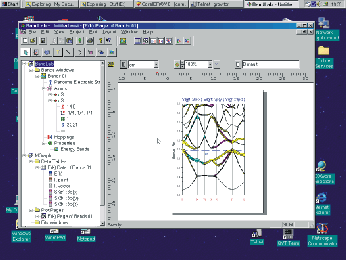
Welcome to MINDLab, the first scientific software for Windows systems which performs electronic structure calculations of crystalline solids. MINDLab uses BandLab library for performing band structure calculations, DMFTLab library for solving impuroty mode and MScene library for visualization purposes. All libraries are dynamically linked to MStudio.
A set of properties which can be computed directly within MINDLab
and further visualized by it includes:
(i) Crystal Group calculations: by setting the atomic positions
the MINDLab shows crystal group operations found for given configuration.
(ii) Fat Bands: fully colored visualization of separated orbital characters
on top of band structures.
Examples can be found in the DataBase/Solids section.
(iii) Density of States: MINDLab computes and visualizes densities of states , total and orbital resoved.
(iv) Hoppings: computations of Hopping integrals for tight-binding fits
(either those which are desired or all possible)
can be done directly within MINDLab.
(v) Optical properties (e1, e2, and electron energy loss spectra)
(vi) 2D visualizations of charge density and full potential.
(vii) Version 2 or later. Full 3D countor plots and 3D visualisations
of the charge density, full potential, Fermi surfaces (compatibility of
3D graphic accelerators with OpenGL is required to use these options)
(viii) Version 2 or later. Crystal structure visualizer. (compatibility of
3D graphic accelerators with OpenGL is required to use these options)
(ix) Version 3 or later. Full 3D support of vector fields visualization
including velocity fields on top of the Fermi surface and 3D magnetizations.
Added features include
Version 2 or later. Complete support of the LDA+U method for correlated electronic systems.
Version 3,4 or later. Extended input and many more options for custom runs.
Several bugs have been also fixed with the present version.
Version 5 or later includes DMFTLab which solves impurity model using dynamical mean-field theory for strongly correlated systems.
Version 7 works with LmtART 7 code
The engine of the MINDLab is a program called LmtART. LmtART is a scientific program developed at the Max-Planck Institute for Solid State Research in Stuttgart, Germany. It is now being maintained and updated by collaboration between the University of California Davis, and Rutgers University. Major contributors include Quan Yin and Xiangang Wan.
The LmtART is an executable file which reads the input data, performs band structure calculation, and stores the output files. The MINDLab controls this process, it prepares input for the LmtART using dialog windows, and starts running LmtART program as a separate thread. When the calculation is finished, LmtART notifies the MINDLab, and the output files read by the framework can be visualized by simple mouse click operations.While running LmtART program for complicated compounds can be rather slow (it depends how many atoms per unit cell is chosen), the MINDLab can be used to prepare the input files, after which they can be copied to another more powerful computer where the LmtART can be executed in much faster way. After run is performed, the output files can be copied back to the PC and analyzed quickly by the MINDLab. All input/output files of LmtART are formatted ASCII files, and therefore system independent.